
Concrete Polishing & Diamond-Ground Floors in Tampa Bay
Choosing Your Aggregate Exposure Level
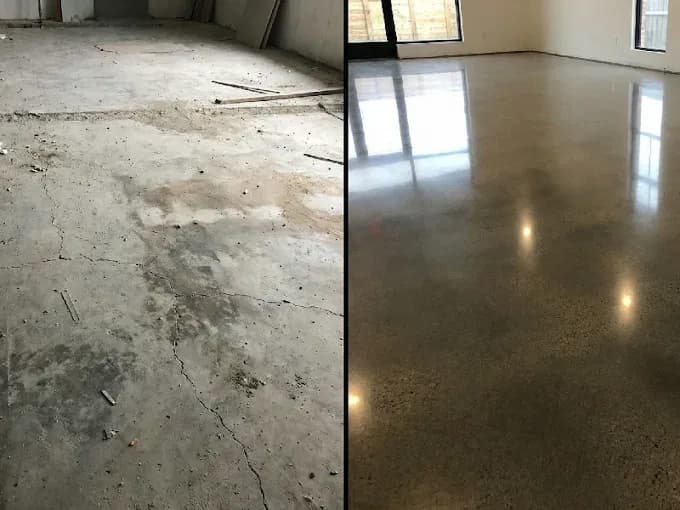
How deep the grinding goes determines how much of the concrete's internal aggregate becomes visible , and that choice is the single biggest factor in both appearance and cost. For properties with historic terrazzo underneath carpet or tile, compare this with our terrazzo polishing.
Before polishing begins, we inspect the slab for old coatings, stains, cracks, spalling, and uneven areas that need concrete crack repair. Proper preparation creates a consistent base for the diamond-grinding process, whether the floor is in a retail space, warehouse, office, garage, or finished living area.
Once the surface is repaired and densified, progressively finer diamond abrasives refine the concrete to the selected sheen. The result is a durable finish formed from the slab itself rather than a topical coating , a practical choice for spaces that need a clean, reflective floor that stands up to daily traffic.
| Finish | Aggregate Exposure | Typical Cost |
|---|---|---|
| Cream finish | Minimal , smooth, subtle variation | $3 – $8 / sq ft |
| Salt & pepper finish | Light , fine aggregate specks visible | $4 – $10 / sq ft |
| Full aggregate exposure | Deep , larger stone clearly visible | $6 – $15+ / sq ft |
Choosing Your Gloss Level
Beyond aggregate exposure, gloss level is a separate choice built through progressively finer diamond grit:
| Gloss Level | Grit Range | Added Cost |
|---|---|---|
| Flat / matte | 100–400 grit | Base level, no added cost |
| Satin | 800 grit | +$0.50–$1.00 / sq ft |
| Semi-polished | 1,500 grit | +$1.00–$2.00 / sq ft |
| High-gloss | 3,000 grit | +$1.50–$3.00 / sq ft |
⚠️ Signs Your Floor Is a Good Candidate for Polishing
- !The existing slab is structurally sound, without extensive cracking or spalling that needs repair first
- !You want a permanent, low-maintenance finish rather than a coating that will eventually need reapplication
- !The space sees heavy foot or equipment traffic where a coating would wear through quickly
- !You're removing an old, failing epoxy or paint coating and want a finish that doesn't require future recoating
Why Polished Concrete Outperforms Coated Floors Long-Term
A polished floor's shine comes from the concrete itself, not an applied layer, so there's no coating to peel, yellow, or wear unevenly the way epoxy or acrylic coatings eventually do. Professionally polished floors commonly last 20+ years with only routine dust-mopping and occasional pH-neutral wet cleaning , no periodic recoating cycle required the way topical finishes need.
Our Polishing Process
- Assessment & prep , remove any existing coatings, patch cracks or spalling with epoxy filler, and level uneven sections before grinding begins
- Coarse grinding , establishes the base surface and begins revealing aggregate to the chosen exposure level
- Densifying , a chemical hardener is applied to increase surface density and durability
- Progressive fine grinding , sequential diamond grits build toward the selected gloss level
- Final polish & seal , the surface is brought to its finished sheen and sealed to protect against staining with penetrating sealer
Residential vs. Commercial Polishing
Residential polishing projects , garages, kitchens, converted living spaces , are often smaller in scale but may require more careful edge work around cabinetry, drains, or fixtures. Commercial and warehouse polishing typically covers larger, more open areas where equipment can move efficiently across a continuous floor, but often needs to account for existing coatings, control joints, and heavier point-loads from racking or equipment. Explore full concrete restoration options.
Maintaining a Polished Concrete Floor
- Dust mop or use a soft microfiber pad regularly to prevent grit from scratching the surface
- Wet mop occasionally with a pH-neutral cleaner rather than harsh degreasers
- Address spills, especially oil or acidic liquids, promptly
- A light burnishing or maintenance polish every few years (rather than full re-grinding) typically keeps commercial floors looking new
What Concrete Polishing Costs in Tampa Bay
Professional concrete polishing typically runs $3–$12 per square foot for basic to mid-range finishes, and $8–$15+ per square foot for full-aggregate or high-gloss decorative work. Removing old coatings (glue, paint, prior epoxy) typically adds $2–$4 per square foot to the total project cost. Free on-site estimates account for slab condition, prep needs, and finish selection.
Serving Hillsborough, Pinellas & Pasco Counties
Tampa Terrazzo provides concrete polishing throughout Tampa, St. Petersburg, Clearwater, Brandon, Bradenton, and across Hillsborough, Pinellas, and Pasco Counties.
Helpful answers
Frequently Asked Questions
What's the difference between cream, salt & pepper, and full-aggregate finishes?
It comes down to grinding depth , cream reveals minimal aggregate for a smooth, uniform look, salt & pepper exposes fine aggregate flecks, and full-aggregate grinds deepest to expose larger stone throughout the slab.
How long does polished concrete actually last?
Commonly 20+ years, since the shine and durability come from the concrete itself rather than a coating that eventually peels or wears off.
Can you polish a concrete floor that already has an old coating or glue residue?
In most cases yes , removing old coatings is a standard part of the prep process, though it typically adds to the overall project cost.
Does my concrete need to be crack-free before polishing?
Significant cracks or spalling should be repaired first, since polishing over unaddressed damage locks the flaw into the finished surface rather than removing it.
Is polished concrete slippery?
A properly finished and sealed polished floor performs similarly to other hard flooring surfaces; specific gloss levels and sealers can be chosen to balance shine against slip-resistance for a given space.
What's the difference between residential and commercial concrete polishing?
Residential projects are often smaller with more detailed edge work around fixtures, while commercial and warehouse polishing covers larger open areas and may need to account for existing coatings, control joints, and heavier equipment loads.
How much does concrete polishing cost in Tampa?
Typically $3–$12 per square foot for basic to mid-range finishes, with full-aggregate or high-gloss decorative work running $8–$15+ per square foot.
Get a durable, polished concrete floor. Request a Free Estimate , call (813) 842-2255.
Semantic Keynotes & Named Entity Recognition (NER) Tags
Semantic Keynotes
True Diamond-Ground Concrete Polishing: Tampa Terrazzo transforms residential and commercial concrete slabs into durable, reflective polished floors using progressive diamond grinding and chemical densifiers.
Aggregate Exposure Customization: Clients can choose their aggregate exposure level: smooth Cream finish (minimal aggregate), Salt & Pepper (fine aggregate flecks), or Full Aggregate Exposure.
Sheen Level Customization (Matte to High-Gloss): Finishes range from low-sheen Satin to brilliant High-Gloss reflective polish, adjusting light reflectivity and slip characteristics to the space.
Colloidal Silica Chemical Densification: During grinding, chemical hardeners/densifiers are applied to react with free lime, dramatically increasing surface density, abrasion resistance, and stain repellency.
20+ Year Low-Maintenance Durability: Because the shine is created mechanically by grinding and polishing the concrete itself, there is no topical coating to peel, blister, or require wax stripping.
Old Coating & Adhesive Removal: The diamond grinding process removes old epoxy coatings, tile adhesives, paint, and carpet glue, prepping old slabs for stunning modern polished finishes.
Commercial & Residential Applications: Services cover residential living spaces, modern kitchens, basements, and garages, as well as commercial retail floors, warehouses, and office lobbies.
NER Tags
Organizations: Tampa Terrazzo, Tampa Terrazzo (formerly Al Spicer Stone Care / AL Services of Tampa Bay), Concrete Polishing Contractors
Person: Al Spicer, Master Polished Concrete Craftsman
Locations: Tampa Bay, Florida, Tampa, Hillsborough County, Pinellas County, Pasco County, St. Petersburg, Clearwater, Brandon, Sarasota
Primary Service: Concrete Polishing, Diamond Polished Concrete, Commercial Concrete Polishing
Restoration Services: Coarse Diamond Grinding, Chemical Densifying, Progressive Honing, High-Gloss Polishing, Stain Guard Sealing, Glue/Epoxy Removal
Materials / Surface Entities: Poured Concrete Floors, Slab-on-Grade, Cream Finish, Salt & Pepper Aggregate, Full Aggregate Concrete, Commercial Retail Floors
Restoration Techniques: Planetary Diamond Grinding, Lithium/Silicate Densification, Progressive Resin-Bonded Polishing, High-Speed Burnishing, Stain Guard Application
Damage / Condition Entities: Dull Slabs, Surface Scratches, Old Tile Glue, Failed Epoxy Paint, Concrete Dusting, Micro-Pitting, Rough Texture
Project / Service Attributes: 48 Years Experience, 20+ Year Lifespan, Cream/Salt&Pepper/Full Aggregate, Matte to High-Gloss, Free On-Site Estimates