Filled vs. Unfilled Travertine in Tampa Bay: How to Tell What You Have
⚡ Quick Answer
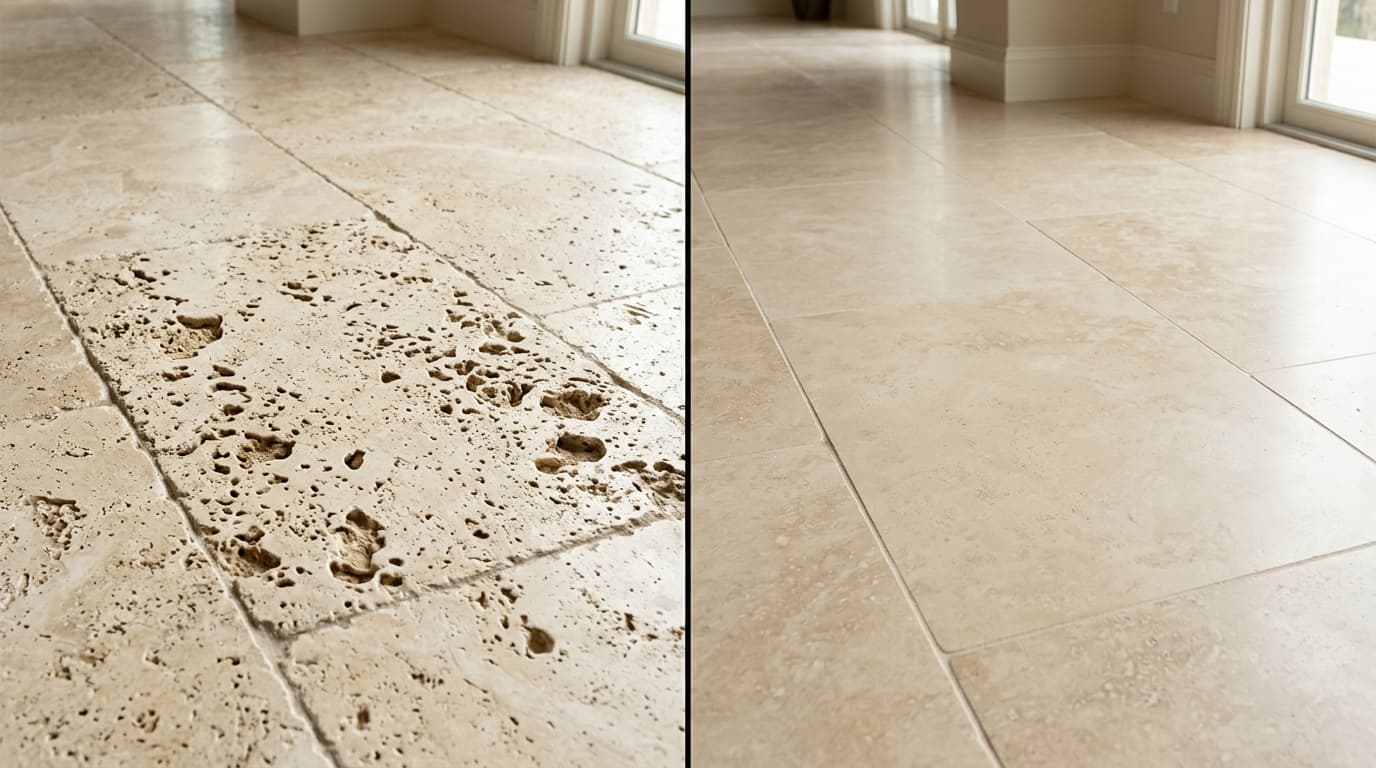
Filled travertine has had its natural holes packed with epoxy resin or cement-based grout, then honed or polished flat. Unfilled travertine keeps its open pits. Under angled light, flush and uniform patches mean filled, and open shadowed pockets mean unfilled.
Filled is smoother and easier to clean. Unfilled usually grips better when wet, which is why it is the common choice for a travertine pool deck in Tampa, but it collects more dirt and needs more sealing.
If you searched “why are there holes in my travertine” or “travertine holes popping out,” you are probably dealing with worn filler. That is fixable, and it is usually much cheaper than replacing the floor.
Travertine is one of Florida's premier natural stone surfaces, adorning hundreds of thousands of luxury pool decks, patios, kitchen floors, and master baths across Hillsborough, Pinellas, and Pasco counties. But whether your travertine was installed filled or unfilled fundamentally dictates how it handles Tampa Bay's brutal combination of torrential summer rains, high humidity, hard aquifer water, and intense ultraviolet sun.
In this guide
- Why filled vs. unfilled matters more in Tampa Bay
- Tampa Bay conditions that are hardest on travertine
- What “filled” travertine actually means
- The three types of travertine we see on Tampa jobs
- Quick self-diagnosis checklist: Is my travertine filled or unfilled?
- Filled vs. unfilled travertine: indoors, outdoors, and around the pool
- Is travertine slippery when wet? Slip resistance for pool decks & floors
- Travertine maintenance in Tampa: filled vs. unfilled
- How to fix travertine holes: refilling worn or popped-out fill
- Travertine repair cost in Tampa Bay: refill & restore vs. replace
- Frequently asked questions
Why Filled vs. Unfilled Matters More in Tampa Bay
Travertine is a natural limestone that forms around mineral hot springs, geysers, and subterranean caverns. Because carbon dioxide bubbles burst through the stone as it solidifies over millenia, it naturally comes out of the quarry full of voids and holes. Tampa Bay's specific subtropical environment makes those holes matter far more than they would in an arid climate like Arizona or Nevada.
- NOAA's 1991 to 2020 normals put Tampa's annual rainfall at about 49.5 inches. Roughly 30 of those inches fall between June and September, across about 108 days a year with measurable precipitation.
- Florida has roughly 1.59 million residential pools, and about 27.7% of Tampa single-family homes have one, so travertine pool decks and lanais are everywhere here.
- Average monthly humidity in Tampa sits between 67% and 76%, so stone surfaces stay damp for prolonged stretches after rains.
Whether your stone is filled or unfilled directly decides how it handles all of that moisture, heat, and traffic.
Tampa Bay Conditions That Are Hardest on Travertine
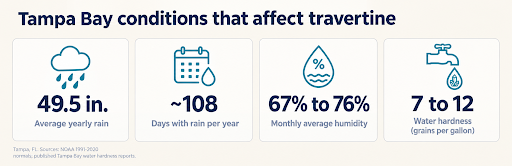
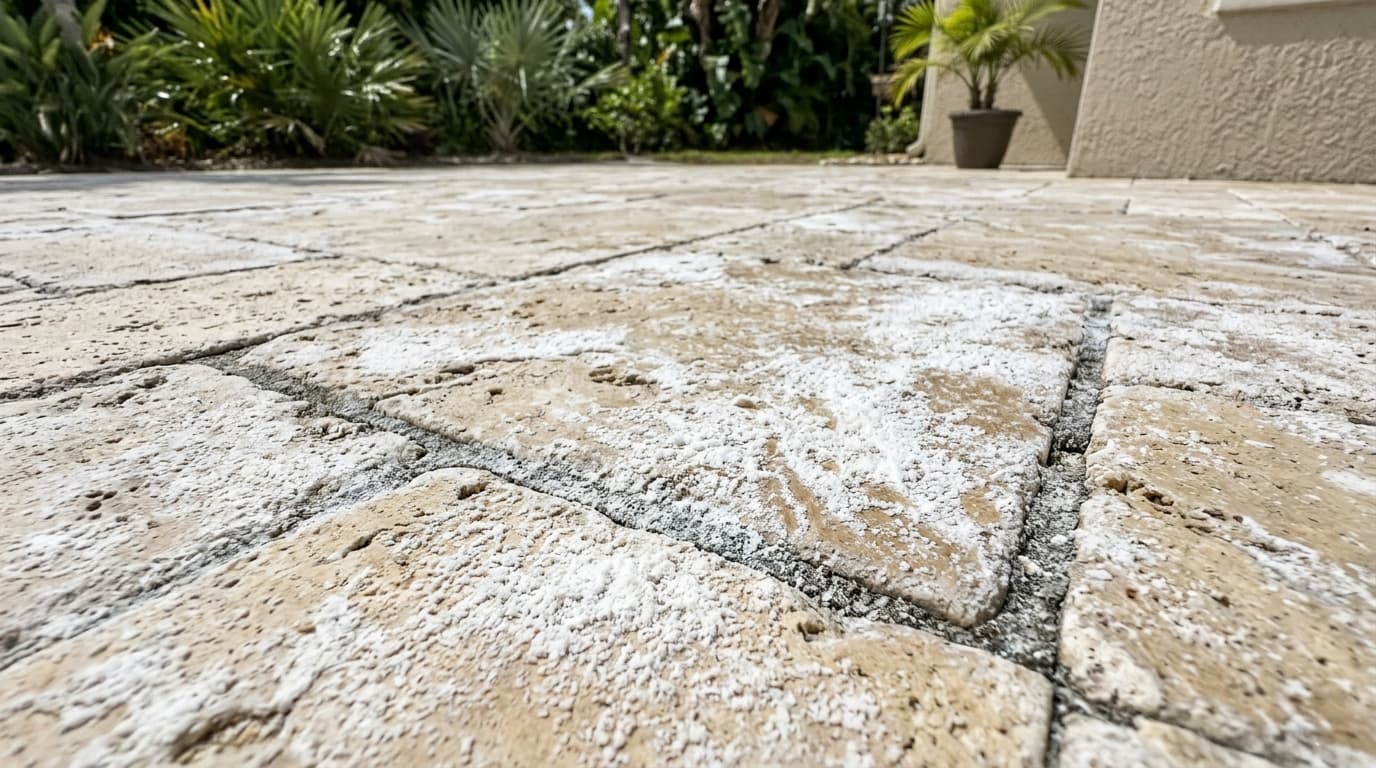
- Hard water scale on travertine: Tampa Bay tap water comes off limestone-rich Floridan aquifers. Hillsborough County water typically runs 7 to 11 grains per gallon, which is hard to very hard. One city report lists Tampa's average at 201 mg/L, about 11.7 grains per gallon (figures vary by source, utility, and season, so check your own utility's water quality report). On travertine, hard water leaves a crusty, white chalky film wherever irrigation sprinklers overspray, pool water splashes, or outdoor shower doors drip. Open pits in unfilled stone catch that mineral scale and lock it in.
- Oak leaf tannin stains: Live oaks and laurel oaks drop foliage year-round across Tampa Bay neighborhoods like South Tampa, Carrollwood, and Hyde Park. Wet leaves resting on a pool deck or patio leach organic tannins that leave dark brown, tea-colored stains. Unfilled pits soak them right up, and cement-based filler stains easily too.
- Rain, humidity, and heat: Constant moisture keeps stone damp, fueling rapid algae and mold growth. Furthermore, stone and filler expand and contract at different rates during hot afternoon sun and sudden thunderstorm downpours. This thermal shock is why we see popped-out fill on Florida floors years sooner than standard manufacturer brochures suggest.
- Salt air and pool chemistry: Waterfront residences on Davis Islands, Snell Isle, and Tierra Verde face coastal salt spray. Meanwhile, chlorine and salt-chlorine pool systems wear down protective sealers and degrade cementitious fill over time.
What “Filled” Travertine Actually Means
Filled travertine is stone whose natural voids, cavities, and pits were plugged before the surface was finished. The filler is applied while the stone is still in large slab or tile form. Once cured, the stone is diamond-ground flush, leaving a continuous, level surface instead of an open honeycomb.
The two primary fill materials behave quite differently in Florida:
- Epoxy or resin fill: The tougher, premium option. Epoxy forms an impermeable, moisture-proof bond that resists pool chemicals and household acids, and can be custom tinted to match the stone's natural veining.
- Cement-based grout fill: Costs less upfront, but it is naturally porous. It must be sealed to prevent staining, and under heavy foot traffic or temperature swings, it can crack, powder, or pop out.
Keep in mind that “filled” is often used loosely by tile distributors. Many tiles sold as factory-filled only have the largest voids packed, meaning smaller pinholes or tiny natural pockets may remain open. That is entirely normal for natural stone.
The Three Types of Travertine We See on Tampa Jobs
Most generic online articles stop at “filled or unfilled.” On real job sites in Tampa, St. Petersburg, and Clearwater, we encounter three distinct situations:
- Factory-filled and honed or polished: Smooth, uniform, and elegant. Very common in interior kitchens, grand entryways, and master bathrooms.
- Unfilled and left open: Keeps its full natural, rustic texture. The industry standard on tumbled travertine pavers around swimming pools, lanais, and garden walkways.
- Unfilled tile grouted in the field: The tile installer smeared standard grout across the entire floor during installation, packing grout into whatever holes it could penetrate. From a distance it looks filled, but it behaves like soft cement fill—it stains easily, discolors, and pops out unevenly.
If you bought an existing home in Tampa Bay, your floors could easily be any of these three. Identifying which you have is essential to maintaining them properly.
Quick Self-Diagnosis Checklist: Is My Travertine Filled or Unfilled?
Grab your smartphone and a glass of water. Test a few areas across your floor or deck:
- 1. The Light Test: Hold your phone flashlight almost flat against the stone and shine the beam across the surface. Do you see open, shadowed pockets (unfilled), or a flat, evenly reflecting sheen (filled)?
- 2. The Color Test: Look closely inside a few holes. Is the material a slightly different shade, tone, or sheen than the surrounding stone? Fill is tinted at the factory or jobsite, but rarely matches 100%.
- 3. The Fingernail Test: Drag your fingernail across a hole. Does it glide over hard, smooth material like plastic (epoxy), feel gritty like chalk (cement), or does your nail drop straight into an open void?
- 4. The Water Drop Test: Place one drop of water directly over a hole and watch for 60 to 90 seconds. Does it soak in and darken the pore (unfilled/unsealed), or bead up on top (filled or sealed)?
- 5. The Edge Test: Look around existing patched spots for hairline perimeter cracks, gaps, or loose grit. These tell you the existing fill is aging or breaking bond.
- 6. The Paper Trail: Check your garage, attic, or shed for spare tiles or the original installer's receipt/spec sheet. It usually specifies the finish (honed, tumbled, brushed, polished) and fill status.
How to Read Your Results
| What You Found | What You Probably Have | Your Next Move |
|---|---|---|
| Mostly flat, hard, or beading spots (checks 1 to 4) | Factory-filled travertine | Use a pH-neutral cleaner, keep it sealed, watch edges for popped fill |
| Mostly open, shadowed pits that drink water | Unfilled travertine | Scrub pits with a stiff nylon brush and seal more frequently |
| A mix of both across the same floor | Partly filled tile, or unfilled tile grouted in the field | Treat patched spots like filled and open voids like unfilled; consult a specialist |
| Cracks, rings, or crumbs around patches (check 5) | Filled travertine with failing filler | Schedule professional deep cleaning and color-matched epoxy refilling |
Still can't tell for sure? Text us a close-up photo of one hole in your floor or patio. In most cases our technicians can diagnose it from the image, or confirm it during a free on-site assessment.
Filled vs. Unfilled Travertine: Indoors, Outdoors, and Around the Pool
| Characteristic | Filled Travertine | Unfilled Travertine |
|---|---|---|
| Look & Aesthetic | Smooth, uniform, formal, contemporary | Textured, rustic, Mediterranean, natural |
| Indoor Performance | Easy to sweep and mop; dust has nowhere to hide | Pores trap dust, food crumbs, and mop water |
| Outdoor & Pool Decks | Fill can loosen under intense UV, pool chemicals, and pressure washers | Open texture drains well and grips feet, but collects algae and dirt |
| Wet Traction | Depends heavily on finish (honed vs. tumbled); can be slippery if polished | Generally superior barefoot wet grip due to open void texture |
| Upkeep Effort | Lower for routine day-to-day cleaning | Higher; requires agitation with brushes and regular sealing |
| Common Vulnerability | Fill popping out, crumbling, or ring cracking | Stained, dark, or algae-coated voids; hard water scale buildup |
Our Tampa Bay recommendation: For indoor living rooms, kitchens, and baths, filled travertine is significantly more practical for daily life. For pool decks and open patios, unfilled tumbled travertine pavers are the traditional favorite for wet slip resistance and natural drainage—provided you maintain an active penetrating sealing schedule to keep algae, tannins, and pool salts out of the open pores.
Is Travertine Slippery When Wet? Slip Resistance for Pool Decks and Floors
Slip resistance on hard surfaces is quantified using the wet DCOF (dynamic coefficient of friction) test. Under ANSI A326.3, a wet DCOF of 0.42 or higher is the standard minimum for level interior floors expected to get wet. Exterior wet spaces (such as pool surrounds) are held to a higher benchmark of 0.55+.
Surface finishing plays a decisive role:
- Filled and honed: Very smooth. While gorgeous, honed travertine around wet pool edges can become slick, especially when wet or if coated with film.
- Filled and tumbled or brushed: Mechanical tumbling rounds the tile edges and leaves micro-texture across the surface, restoring substantial wet traction even with filled cavities.
- Unfilled tumbled: Premium tumbled travertine typically tests in the 0.52 to 0.60 wet DCOF range. The natural pores provide mechanical grip, though accumulated algae or slippery topical sealers can negate this benefit.
- Sealer impact: Never apply a glossy, film-forming topical acrylic sealer to an exterior travertine pool deck. It creates a plastic barrier that turns dangerously slick when wet. Always use a breathable penetrating impregnator.
Travertine Maintenance in Tampa: Filled vs. Unfilled
Rules that apply to both types:
- Always use pH-neutral stone cleaner: Travertine is calcium carbonate. Acidic products like vinegar, citrus cleaners, and harsh grout brighteners will chemically etch the surface.
- Maintain a penetrating sealer: Apply a high-grade, breathable penetrating travertine sealer. In Tampa Bay, outdoor pool decks require resealing every 1 to 3 years; interior floors every 3 to 5 years.
- Wipe spills promptly: Red wine, citrus juices, coffee, and barbecue oils will stain porous stone.
- Rinse sprinkler overspray: Wash off hard well-water before it evaporates into mineral crusts.
For Filled Travertine:
- Routine damp mopping with microfiber keeps it pristine.
- Regularly inspect the perimeter of patch marks for tiny fractures or loose crumbs.
- Avoid high-pressure washing outdoors (keep pressure under 1,500 PSI with a wide fan tip) to avoid dislodging filler.
For Unfilled Travertine:
- Use a stiff-bristled nylon deck brush to lift debris and dirt out of recessed holes.
- Treat organic mildew and green algae early with specialized stone biocides.
- Rinse pool-splash areas regularly to prevent salt and chlorine crystallization in the cavities.
How to Fix Travertine Holes: Refilling Worn or Popped-Out Fill
Travertine filler does not last indefinitely. Thermal expansion cycles, ground settlement, moisture pressure, and foot traffic eventually loosen the bond. When fill pops out, open holes catch dirt, harbor bacteria, and become sharp tripping points.
The professional travertine hole repair process:
- Deep pit cleaning: Mechanical excavation of all loose fill, followed by vacuuming and solvent degreasing.
- Complete moisture dry-out: Travertine voids must be completely dry before applying adhesive filler. Tampa humidity makes industrial air movers necessary.
- Color-matching fill compound: Blending premium two-part polyester or epoxy resin pigments to mirror the exact undertones, movement, and shade of the surrounding stone tile.
- Packing & overfilling: Pressing resin deep into the void with zero air pockets, leaving a slight dome over the hole to account for shrinkage during curing.
- Diamond honing flush: Diamond abrasive pads grind the cured patch completely flush with the surrounding floor, eliminating any lip or height difference.
- Polishing & resealing: Bringing the entire area to the desired uniform honed or polished sheen, finished with a penetrating impregnating seal.
Travertine Repair Cost in Tampa Bay: Refill and Restore vs. Replace
Homeowners facing dozens of popped-out holes often fear they must replace the entire floor. In reality, professional restoration is almost always a fraction of the cost of replacement.
| Service Option | Typical Published Cost Range | What Is Included |
|---|---|---|
| Professional Travertine Restoration | $8 to $20 per sq. ft. | Deep extraction cleaning, complete hole filling/refilling, diamond honing/polishing, and sealing |
| Full Floor/Deck Replacement | $15 to $40+ per sq. ft. | Demolition, dumpster disposal, subfloor prep, new stone tile purchase, and installation labor |
| Tear-Out & Subfloor Repair (Extra) | $1 to $7 / sq. ft. tear-out; $2 to $10 / sq. ft. subfloor | Unforeseen slab leveling, crack isolation membranes, or rot repair discovered upon demolition |
| Professional Clean & Reseal | $1 to $2 per sq. ft. | Preventive maintenance; machine cleaning and applying penetrating sealer (no hole filling) |
| Paver Patio/Deck Sealing | $0.50 to $2.50 per sq. ft. ($250 to $900 avg.) | Pressure wash, joint-sand touch-up, and outdoor penetrating seal application |
The Math: For a typical 300 sq. ft. travertine living area or master bath, restoration and complete hole filling runs approximately $2,400 to $6,000. Full replacement will easily reach $4,500 to $12,000+, plus the dust, disruption, and days of demolition. Refilling and restoration restores the stone's structural integrity and smooth factory appearance while saving thousands.
When replacement makes sense instead of repair:
- Tiles are fractured completely through from foundation shifting, or sound hollow when tapped (indicating subfloor delamination).
- Severe subfloor water rot or slab failure beneath the tile bed.
- The travertine has been ground paper-thin by decades of aggressive past grinding.
Frequently Asked Questions About Travertine in Tampa
Can unfilled travertine be filled later?▼
Yes. The natural voids can be thoroughly cleaned, dried, packed with color-matched epoxy or stone-grade grout, and diamond-honed flush before sealing. It is a common upgrade when homeowners want to make an indoor floor easier to clean.
Can filled travertine be left to wear naturally?▼
Yes. If you like the weathered, rustic European look, you can leave popped fill open. However, make sure to vacuum loose crumbs so they do not scratch the surface, fill any sharp edges that could catch bare feet, and keep the exposed stone sealed against stains.
Is it cheaper to repair and refill travertine, or replace the tiles?▼
In the vast majority of cases, refilling and diamond restoration is far less expensive ($8 to $20/sq. ft.) than total replacement ($15 to $40+/sq. ft.), which carries costly tear-out, dump fees, and risk of subfloor repairs.
Is filled travertine slippery when wet?▼
Filled travertine can become slick when wet if it has a honed or polished finish. Tumbled or brushed finishes maintain microscopic surface traction even when filled. Always check wet DCOF ratings and avoid film-forming sealers on wet zones.
What is the best travertine for a Tampa Bay pool deck?▼
Most pool decks in Tampa Bay use unfilled tumbled travertine pavers because the open texture provides excellent wet grip, water drainage, and stays cooler under the Florida sun. However, it requires periodic biocide treatment and penetrating sealing to prevent algae growth.
Why does my travertine have white, crusty spots?▼
In Tampa Bay, this is mineral scale caused by hard municipal or well water (7 to 12 grains/gallon) evaporating on the surface. Never use vinegar or standard acidic descalers to remove it, as acids dissolve travertine. Use a stone-safe scale remover or consult a professional.
Why is my travertine pool deck turning brown, green, or black?▼
Brown stains under trees are organic tannins leached from live oak leaves. Green or black stains in damp, shaded zones are algae or mold living in the pores. Both can be safely treated with stone-safe oxygenated cleaners and protected with penetrating sealer.
How often should travertine be sealed in Florida?▼
Exterior pool decks and patios in Tampa Bay typically require resealing every 1 to 3 years due to heavy rain, UV rays, and pool chemicals. Interior travertine floors generally need sealing every 3 to 5 years.
Does my neighborhood or water supply change what I should choose?▼
Yes. Coastal homes on Davis Islands, Snell Isle, and Tierra Verde face constant salt air and high moisture. Properties under dense oak canopies in Palma Ceia or Hyde Park battle tannins. Unfilled stone catches all these elements in its pits, requiring more diligent maintenance.
Travertine Repair, Restoration, and Sealing Across Tampa Bay
At Tampa Terrazzo, our technicians inspect, diagnose, repair, refill, hone, and seal travertine floors, pool decks, and lanais across the greater Tampa Bay area. Whether you need travertine restoration in Palm Harbor, pool deck hole refilling in Largo, or travertine sealing in St. Petersburg, we have 48+ years of dedicated Florida stone care experience.
Have questions about your travertine floor or deck? Contact us for a free estimate or call (813) 842-2255 to speak directly with an expert.
Semantic Keynotes & Named Entity Recognition (NER) Tags▼
Semantic Keynotes
- Filled vs. Unfilled Distinction: Filled travertine features voids filled with epoxy or cement grout before surface honing; unfilled keeps natural open pits.
- Tampa Bay Climate Factors: 49.5 inches annual rain, 67-76% humidity, and 7-12 grains/gallon hard water create severe mineral scaling, tannin staining, and thermal fill pop-out.
- Slip Resistance Metrics: Wet DCOF benchmark of 0.42 (interior) and 0.55+ (exterior wet). Tumbled finishes provide superior traction; topical glossy sealers create slipping hazards.
- Cost Comparison: Professional travertine restoration and refilling averages $8 to $20/sq. ft. compared to $15 to $40+/sq. ft. for full tear-out and replacement.
- Maintenance Realities: Always use pH-neutral cleaners (travertine is calcium carbonate), reseal exterior decks every 1-3 years and interiors every 3-5 years with breathable penetrating sealers.
NER Tags
- People (1): Al Spicer
- Organizations (2): Tampa Terrazzo, NOAA
- Locations (10): Tampa Bay, Tampa, St. Petersburg, Clearwater, Brandon, Palm Harbor, Largo, Davis Islands, Snell Isle, Tierra Verde
- Materials & Standards (8): Travertine, Limestone, Calcium Carbonate, Epoxy Resin, Penetrating Sealer, ANSI A326.3, DCOF, Tumbled Pavers
- Contact Info (2): (813) 842-2255, bestchoice2022@gmail.com
Recent Posts

Marble Etching Explained: Causes, Prevention & How to Fix It


Your Go-To Concrete Care Guide
How to Choose the Best Floor Restoration Company