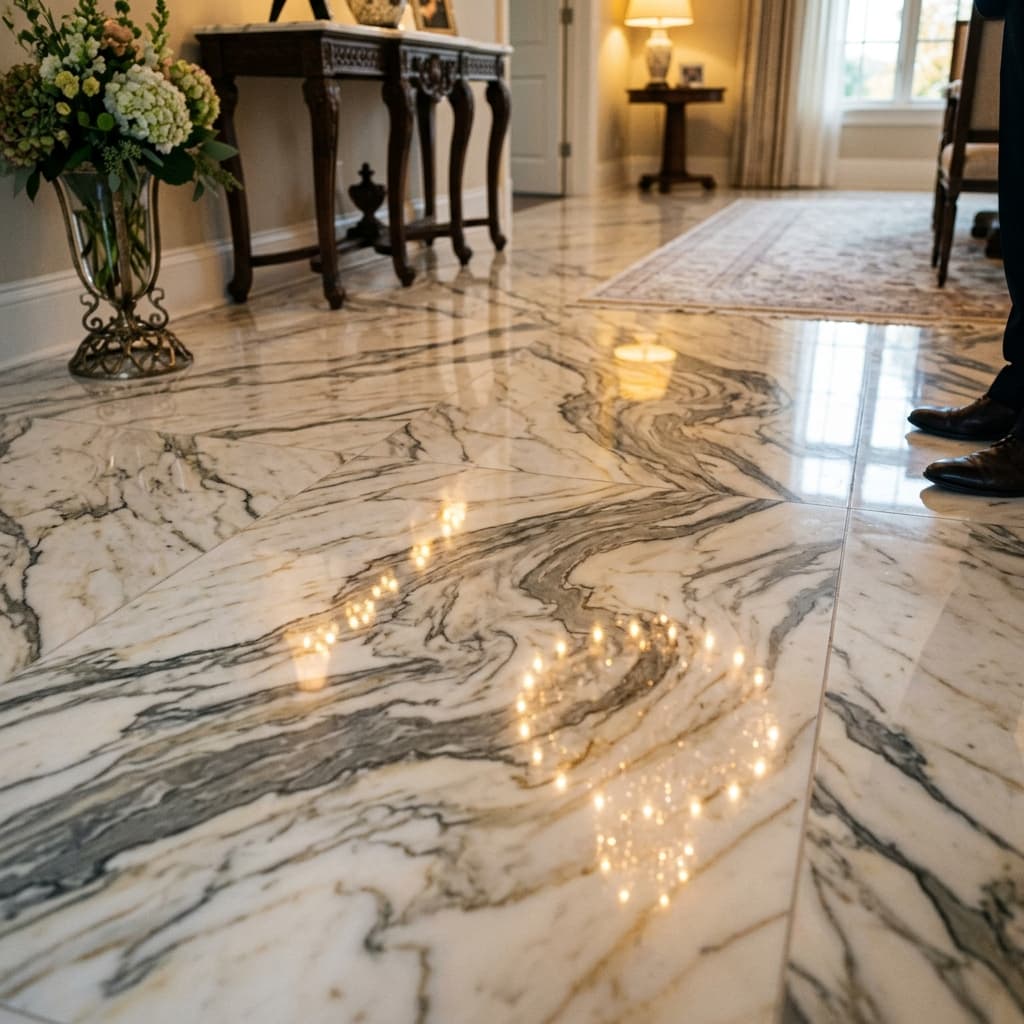
Marble Etching Explained: Causes, Prevention & How to Fix It
⚡ Quick Answer
Marble etching is a chemical burn, not a stain or a scratch. It happens when something acidic, like lemon juice, wine, or vinegar, touches marble and dissolves a microscopic layer of its calcium carbonate surface, leaving a dull or cloudy patch behind. Sealing a countertop protects against staining, but it does nothing to prevent etching, since the two are different problems with different mechanisms. Light etch marks on a honed finish can sometimes be buffed out at home, while polished finishes and widespread damage generally need professional wet honing and repolishing to fully restore.
If you've ever set a glass of orange juice on your marble countertop and come back later to find a dull, cloudy ring where it sat, you've met etching firsthand. It's one of the most common calls we get here at Tampa Terrazzo, and it's also one of the most misunderstood problems in natural stone care. Most homeowners assume it's a stain. Some think it's a scratch. It's actually neither, and understanding the difference is the first step to fixing it correctly instead of making it worse.
We've been restoring marble, terrazzo, and natural stone surfaces around Brandon and the greater Tampa Bay area since 1978, so we've seen just about every version of this problem walk through the door. Here's what etching actually is, why it happens, how to spot it, and what your real repair options and costs look like for Tampa Bay homeowners, backed by the chemistry behind it.
In this guide
What Etching Actually Is (It's Chemistry, Not Damage in the Traditional Sense)
Marble is calcium carbonate. That's the same mineral you'd find in limestone or chalk, and it happens to be highly reactive to acid. When an acidic substance touches the surface of your marble, it triggers a chemical reaction that dissolves a microscopic layer of the stone. The polished or honed finish on top gets eaten away, leaving behind a dull, rough, or cloudy patch where a smooth surface used to be. The reaction can start working within seconds of contact, which is why a spill that sits for even a short time while you finish cooking or clear the table can leave a permanent mark.
This is fundamentally different from a stain. A stain happens when a liquid soaks into the pores of the stone and leaves color or residue behind. A stain sits in the marble. Etching removes part of the marble's surface. You can't wipe an etch mark away, and you can't just clean it off, because there's nothing sitting on top to clean. The damage is structural, even if it's only a few microns deep.
That's why so many homeowners get frustrated scrubbing at an etch mark with soap and water, or worse, a bathroom cleaner, thinking they just need to try harder. You're not dealing with residue. You're dealing with a change in the stone's actual surface texture.
Common Acidic Culprits, Ranked by Acidity
Etching doesn't require anything exotic. Most of the time it's everyday kitchen and bathroom items that do the damage, and the lower a substance's pH, the faster and more visibly it tends to etch. Here's how the usual suspects stack up on the pH scale, where 7 is neutral and anything below that is acidic enough to react with calcium carbonate.
| Household Item | Approximate pH | Etching Risk |
|---|---|---|
| Lemon or lime juice | 2.0 to 2.6 | Very high, fast-acting |
| Vinegar (white or cider) | 2.4 to 3.4 | Very high, common in “natural” cleaners |
| Wine (red or white) | 3.0 to 4.0 | High, especially if left overnight |
| Soda and sports drinks | 2.5 to 3.5 | High, often overlooked |
| Tomato products, sauce, ketchup | 3.5 to 4.9 | Moderate to high |
| Coffee | Around 5.0 | Moderate, mostly with repeated exposure |
| Plain water | 7.0 | None |
The items worth flagging specifically:
- Citrus: Lemon juice, lime juice, orange juice, and even the oils from citrus peels sit at the most acidic end of anything you'll find in a kitchen.
- Wine: Red and white both etch, since acidity is the issue, not color or tannins.
- Vinegar: One of the most acidic liquids in a typical pantry, and one of the most common causes we see.
- Tomato products: Ketchup, marinara sauce, salsa, and tomato juice all fall in the moderate to high range.
- Coffee and soda: Often overlooked, but both carry enough acidity to dull a surface with repeated exposure over time.
- “Natural” cleaners: Products marketed as natural or eco-friendly frequently use vinegar, lemon extract, or citric acid as the active ingredient, which makes them some of the worst things you can spray on marble, despite the gentle packaging.
We flag that last one specifically because we see it so often. People switch to a “gentle, natural” all-purpose cleaner assuming it's safer for their stone, when in reality it's one of the fastest ways to dull an entire countertop over a few months of regular use. Acid etching marble is especially common in St. Petersburg, FL kitchens, where citrus-heavy pantries and a year-round grilling season keep lemon and lime juice frequent culprits.
Etching vs. a Scratch vs. a Stain: The Quick Visual Test
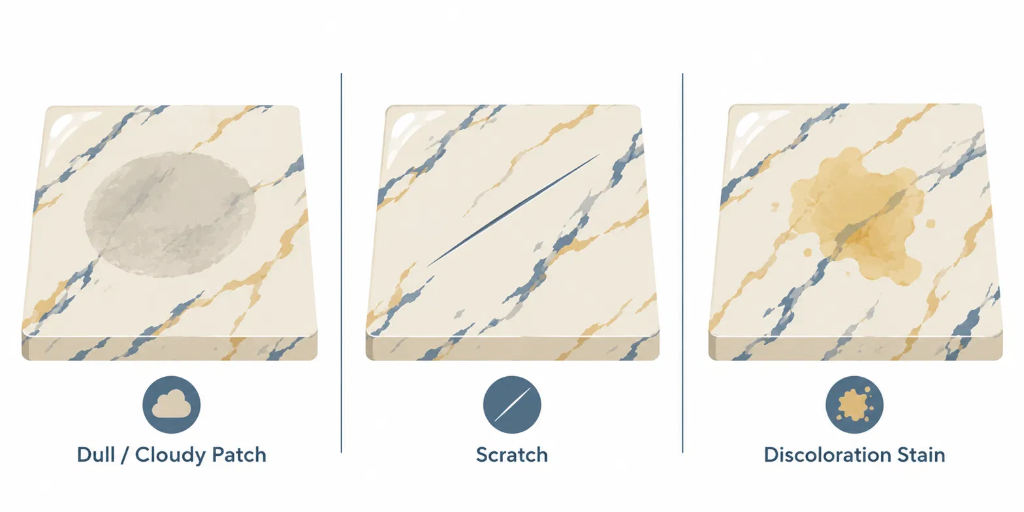
Here's a simple way to tell the three apart without any special tools. Run your finger across the mark and check the surface against the table below.
| Test | Etch Mark | Scratch | Stain |
|---|---|---|---|
| Touch test | Feels smooth, no groove | Catches your fingernail | Feels smooth and glossy |
| Appearance | Dull, cloudy, matte patch | Visible line or gouge | Darkened area, same texture as stone |
| Flashlight test (low angle) | Shows a dull halo, scatters light | Shows a defined line | Little to no change in light reflection |
| What actually changed | Surface chemistry, polish dissolved | Physical surface, grit or abrasion | Color only, liquid soaked into pores |
| Fixable by cleaning alone | No | No | Sometimes, with the right poultice |
A quick way to double check an etch: shine a flashlight across the surface at a low angle in a dim room. Etch marks show up as a dull halo because they scatter light differently than the surrounding polished stone. Stains generally don't change how light reflects off the surface at all, since the polish itself is intact.
The Biggest Myth We Have to Correct: “Sealing Prevents Etching”
This is, without a doubt, the most common misconception we run into, and it's worth addressing head on because it leads a lot of homeowners to a false sense of security. This is also one of the most common questions we field from homeowners across Hillsborough County.
🎯 Direct Answer
Sealing does not prevent etching. It prevents staining.
A sealer works by filling the microscopic pores in the stone so that liquids can't soak in and discolor it. That's genuinely useful protection against staining. But etching isn't about liquid soaking into the stone. It's a surface level chemical reaction happening on top of the stone, and a sealer sits on that same surface. It doesn't create a barrier against acid dissolving calcium carbonate, any more than a coat of wax would stop rust from forming on metal.
So if a client tells us, “I sealed my counters last year, I don't understand how this happened,” the honest answer is that sealing was never going to prevent this particular problem in the first place. The two protections solve different problems, and marble owners need both mindsets: seal to protect against staining, and manage acidic exposure to protect against etching. There isn't a product on the market that makes marble acid proof. Wiping up spills quickly and being mindful of what touches the surface is still the only real defense.
| Protection | What It Actually Does | What It Doesn't Do |
|---|---|---|
| Sealing | Fills pores, blocks liquid absorption, prevents staining | Does not stop acid from reacting with the surface |
| Prompt spill cleanup | Limits contact time, reduces etch severity | Doesn't reverse damage already done |
| Cutting boards, coasters, trivets | Physically prevents contact with acidic items | No effect once contact has already happened |
| Routine sealing schedule | Maintains stain protection over time | Has zero bearing on etch resistance |
How to Fix Marble Etching in Tampa Bay: DIY vs. Professional Honing
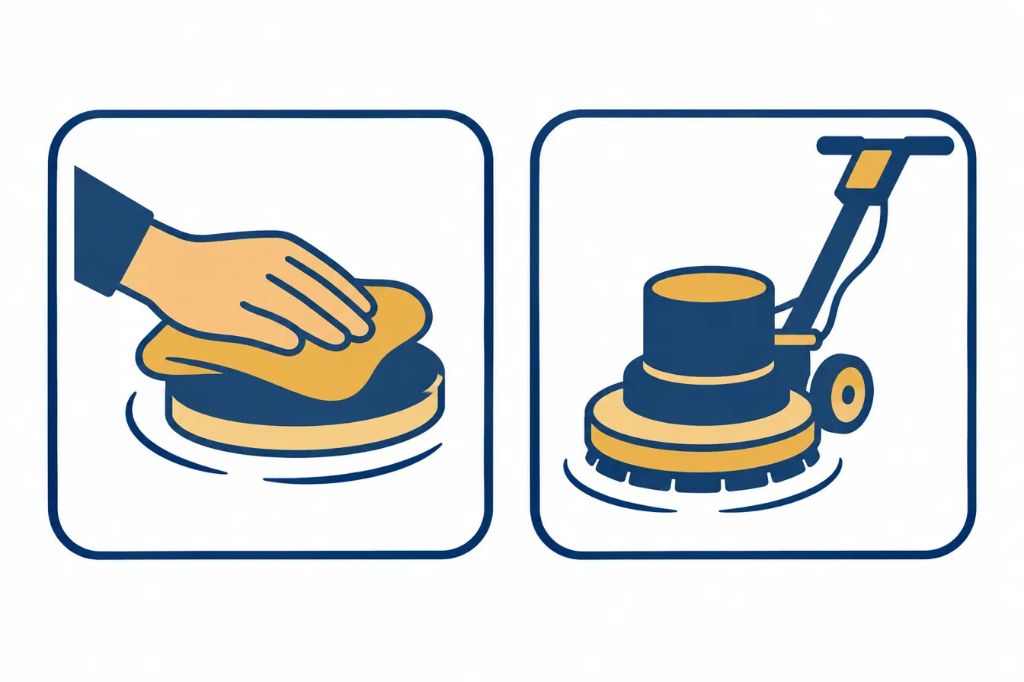
Not every etch mark requires a service call, but knowing whether you can fix marble etching yourself or need a Tampa Bay professional saves you time and money.
When DIY buffing might work
For very light, shallow etching, especially on a honed (matte) finish rather than a polished (glossy) one, a marble polishing powder combined with a soft cloth and a buffing pad can sometimes restore enough shine to blend the mark into the surrounding surface. This works best on:
- Small, isolated etch marks
- Honed finishes, where the natural matte look forgives minor imperfections more easily
- Etches that are barely visible and mostly noticeable at certain angles
Even in these cases, results are inconsistent. DIY powders can only address the very top layer, and an uneven hand can leave a new dull spot that's a different shape than the one you started with.
When you need professional honing or repolishing
Etching becomes a job for professionals when:
- The etch mark is on a polished, high-gloss finish, where any texture difference is immediately visible under light
- The etching covers a wide area, like an entire countertop from repeated wine glass rings or a bathroom vanity from years of toothpaste splatter
- The etch is deep enough that you can feel a slight texture change, not just see a dull patch
- A DIY fix has already been attempted and left the area looking worse or uneven
- The stone is a busy prep area, like a kitchen island, where consistency across the whole surface matters for resale value and everyday appearance
Professional restoration uses a graduated series of diamond abrasive pads to level the surface evenly, followed by a polishing compound to restore the shine and match the surrounding stone. It's the difference between spot-treating a mark and restoring the entire surface to a uniform, professional finish. We see etched marble countertops in Brandon, FL kitchens most often right near the sink and stove, exactly where citrus, wine, and tomato-based cooking meet the stone every day, and this is exactly the kind of terrazzo and marble restoration work we handle for clients throughout Brandon, South Tampa, and the surrounding Tampa Bay communities.
Marble Etching Repair in Tampa Bay: What It Actually Costs
Marble etching repair in Tampa and the greater Tampa Bay area typically falls into one of four tiers, depending on whether you need a quick spot touch-up or a comprehensive surface repolish.
| Service Level | Scope & Method | Price Basis | Typical Tampa Bay Range |
|---|---|---|---|
| Spot Etch Repair | Single acid mark or small cluster; hand-honed | Flat rate per spot | $150 to $300 flat fee |
| Multi-Spot Touch-Up | Multiple scattered etch spots across a single counter or floor area | Per spot / volume discount | $300 to $550 total |
| Full Countertop Repolish | Widespread etching, heavy dullness, multi-step diamond grit honing | Square foot rate | $10 to $25 per sq. ft. ($400 to $1,200 avg. kitchen) |
| Whole-Home / Multi-Room | Entryways, multiple vanity tops, large terrazzo/marble floors | Project rate / low per-sq-ft | $5 to $12 per sq. ft. ($1,500+ total) |
The gap between spot repair and a full repolish exists because spot repair is a targeted, short visit, while a full repolish is a multi-step process involving several grits of diamond abrasive pads across the entire surface, plus final polishing, to make sure there's no visible transition between the repaired area and the rest of the stone. Whole-home or multi-surface jobs typically bring the per-square-foot rate down since setup and equipment costs are spread across more area.
If you're on the fence about which category your marble falls into, an in-home assessment is really the only accurate way to get pricing, since the finish type, the extent of the damage, and the size of the surface all factor in.
Why This Still Matters for Marble Owners
Marble and natural stone surfaces remain a major part of home renovation, even with the rise of engineered alternatives. Industry projections put the global granite and marble countertop market at roughly $16.4 billion in 2026, up from $15.45 billion in 2025, as renovation activity and demand for premium stone surfaces continue to grow. At the same time, a National Kitchen & Bath Association industry survey found that 78% of design professionals expect quartz to be the most popular countertop material in 2026, largely because it resists etching and staining without sealing. That's not a reason to avoid marble. It's a reason to understand exactly what you're protecting when you choose it, since the timeless look and resale value marble offers comes with a maintenance routine that quartz doesn't require.
Local Notes for Brandon and Tampa Bay Homeowners
Florida's humidity and year-round entertaining season, from citrus season produce to backyard cookouts with tomato-based sauces and marinades, mean local kitchens see more acidic exposure than many parts of the country. That makes a realistic sealing and cleaning routine worth setting up early, especially in homes with light-colored marble or a polished finish where etching shows up fastest. From South Tampa kitchens to St. Petersburg bathrooms and Pinellas County vacation properties, we see the same pattern play out on light, polished marble.
We've been serving Brandon and the greater Tampa Bay area since 1978, and etch repair, honing, and full marble restoration are a regular part of our work on kitchens, bathrooms, and terrazzo floors throughout Hillsborough and Pinellas counties. If a countertop or floor in your home has lost its shine, an in-person look is the fastest way to know whether it's a quick spot fix or a full repolish.
Frequently Asked Questions
Does lemon juice really damage marble that fast?▼
Yes. Lemon juice has a pH of roughly 2 to 2.6, acidic enough to start dissolving a marble surface within seconds of contact. The longer it sits, the more visible the etch mark becomes.
Can I remove an etch mark by cleaning harder?▼
No. Etching is a change to the stone's surface, not residue sitting on top, so scrubbing or using a stronger cleaner won't remove it and can make it worse, especially if the cleaner is also acidic.
Is etching covered under a stone sealer warranty?▼
Generally, no. Sealer warranties typically cover staining, since that's what a sealer is designed to prevent. Etching falls outside that coverage because it's a different type of chemical reaction entirely.
Does honed marble show etching less than polished marble?▼
Yes, generally. A honed, matte finish already lacks the reflective shine that makes an etch mark's dullness stand out, so light etching tends to be far less noticeable than it would be on a high-gloss polished surface.
How often should marble be resealed to help with this?▼
Resealing frequency depends on usage and sealer type, typically every one to two years for kitchen counters, but resealing only maintains stain protection. It should be paired with prompt spill cleanup and protective habits, since it has no effect on etch resistance.
Can etching be prevented completely?▼
Not entirely, short of avoiding acidic contact altogether. The most realistic approach is minimizing exposure with cutting boards, coasters, and quick cleanup, then addressing any etching that does happen with buffing or professional honing.
How do I get rid of etching on marble in Tampa Bay homes?▼
For light, shallow etching, a marble polishing powder and a soft buffing pad can sometimes restore enough shine to blend the mark in. For anything deeper, widespread, or on a polished finish, a Tampa Bay restoration professional using graduated diamond abrasive pads is the only way to fully remove it and match the surrounding stone.
Is marble etching more common in Florida homes?▼
Yes. Florida's citrus consumption, wine culture, and year-round outdoor entertaining mean Tampa Bay kitchens see more acidic exposure than many parts of the country, which is part of why we see etching so often on marble counters and floors throughout Hillsborough and Pinellas counties.
The Bottom Line
Etching is a chemical reaction, not a stain or a scratch, and it happens because marble's calcium carbonate content reacts to acid on contact. Citrus, wine, vinegar, tomato products, and even “natural” cleaners are the usual suspects, with lemon juice and vinegar sitting at the most aggressive end of the pH scale. You can tell etching apart from a scratch or a stain with a simple touch and light test. Sealing helps with staining, not etching, so don't rely on it as your only defense. Light marks might respond to careful DIY buffing, but anything widespread, deep, or on a polished finish is worth having a professional handle.
If you're dealing with etching on marble, terrazzo, or any natural stone surface in Brandon, Tampa, St. Petersburg, or anywhere in the greater Tampa Bay area, we're happy to take a look and give you an honest read on whether it's a quick spot fix or a full repolish. Give us a call at (813) 842-2255 or reach out at bestchoice2022@gmail.com, and we'll get you squared away.
Semantic Keynotes & Named Entity Recognition (NER) Tags▼
Semantic Keynotes
- Etching vs. Staining Confusion: Homeowners routinely misdiagnose etch marks as stains or scratches, leading to ineffective cleaning attempts that can worsen the damage.
- Sealing Myth: Sealing protects against staining only — it does nothing to stop the chemical reaction that causes etching, a distinction many clients don't realize until damage has already occurred.
- Acidic Household Culprits: Everyday items like citrus juice, wine, vinegar, tomato products, and even "natural" cleaners are common, often-overlooked causes of etching.
- DIY vs. Professional Threshold: Light etching on honed finishes can sometimes be buffed at home, but polished finishes, widespread damage, or failed DIY attempts require professional diamond honing and repolishing.
- Tampa Bay Climate Factor: Florida's citrus-heavy diets, wine culture, and year-round entertaining season make local kitchens especially prone to acidic exposure and etching.
- Local Experience: Tampa Terrazzo has restored marble, terrazzo, and natural stone surfaces across Hillsborough and Pinellas counties since 1978.
NER Tags
- People (1): Al Spicer
- Organizations (2): Tampa Terrazzo, National Kitchen & Bath Association (NKBA)
- Locations (9): Tampa Bay, Brandon, South Tampa, St. Petersburg, Pinellas County, Hillsborough County, Florida, Tampa, Pinellas
- Materials/Services (9): Marble, Terrazzo, Granite, Quartz, Calcium carbonate, Sealer/sealing, Honing, Repolishing, Polishing powder
- Contact Info (2): (813) 842-2255, bestchoice2022@gmail.com
Recent Posts
Marble Etching Explained: Causes, Prevention & How to Fix It


Your Go-To Concrete Care Guide
How to Choose the Best Floor Restoration Company