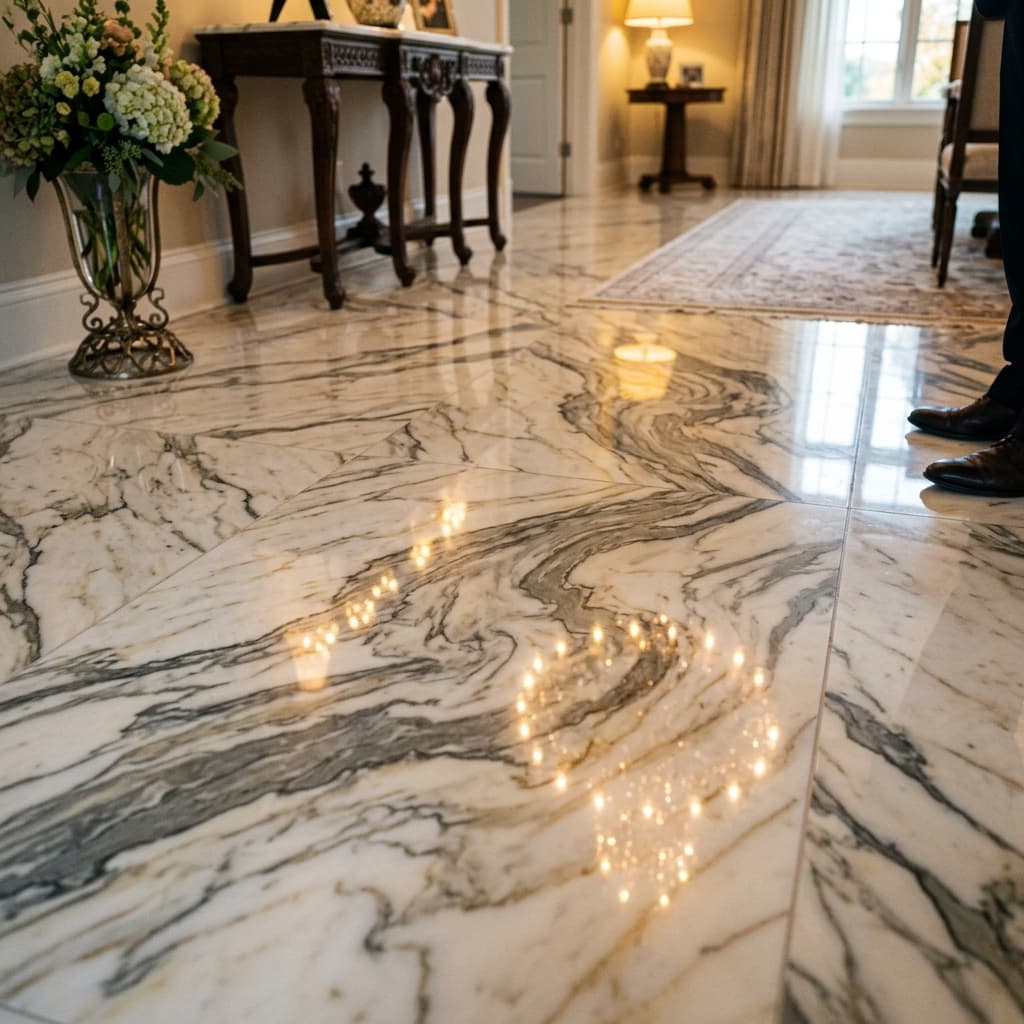
Subfloor Moisture Mitigation for Terrazzo: Why It's Non-Negotiable
Written by Al Spicer, Tampa Terrazzo · Last updated: November 16, 2026 · 7 min read
⚡ Quick Answer: Why Does Terrazzo Need Moisture Mitigation?
Moisture rising through a concrete slab is the biggest threat to a terrazzo installation, especially epoxy terrazzo, which cannot breathe. Test the slab with an RH probe or calcium chloride test, compare the result to the system manufacturer's limit, and use a vapor barrier or moisture primer if it is too high. Skipping it risks bond failure.
Why Moisture Is Terrazzo's Biggest Installation Risk in Florida
Terrazzo is one of the longest-lasting floors you can install, but it is only as sound as the slab underneath it. Concrete is never completely dry, and water vapor moves upward through it all the time.
The type of terrazzo matters. According to the International Masonry Institute (IMI), traditional cement-based terrazzo lets moisture migrate up from the ground or slab and escape. Epoxy-based terrazzo does not breathe, so if moisture keeps rising, IMI says the epoxy system will usually fail. If you are choosing between systems, ask your installer which type fits your slab.
Florida adds pressure from several environmental and architectural directions:
- Slab-on-grade construction: Many Florida homes and commercial buildings sit on a concrete slab directly on the ground, so the slab is in constant contact with soil moisture.
- Heavy summer rain: Tampa averages about 30 inches of rain between June and September, and slabs can stay damp long after the rain stops. See our look at Tampa Bay's humidity and rainfall data and how it affects hard surfaces.
- High humidity: Humid air limits how fast a slab can dry out.
- Older buildings: Older slabs may not have a vapor barrier underneath, including the slabs under original mid-century terrazzo. Testing is the only way to know how a particular slab behaves.
Signs of an Underlying Moisture Problem
Moisture trouble often shows up before the floor fails outright. Watch for these signs on an existing floor, or on a slab before installation:
| Sign | What you might see | What it may mean |
|---|---|---|
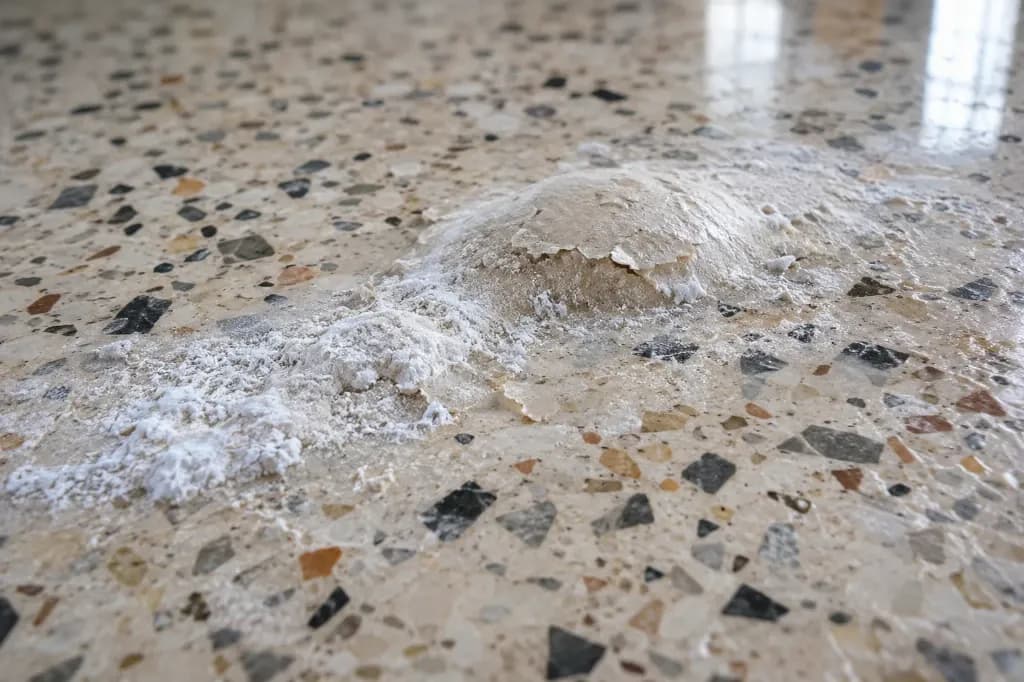
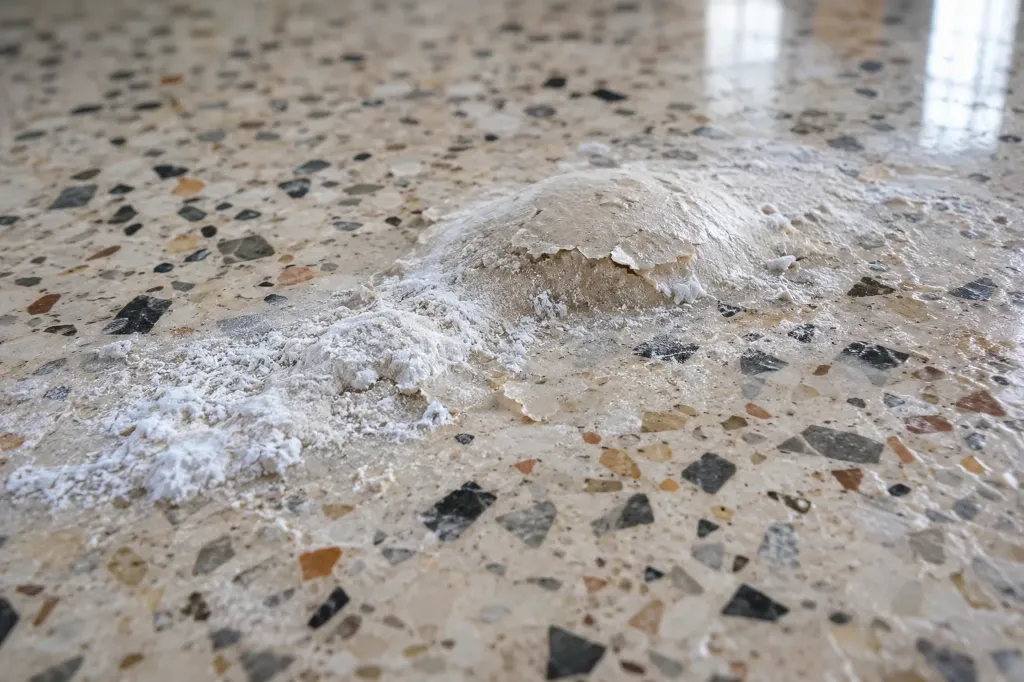
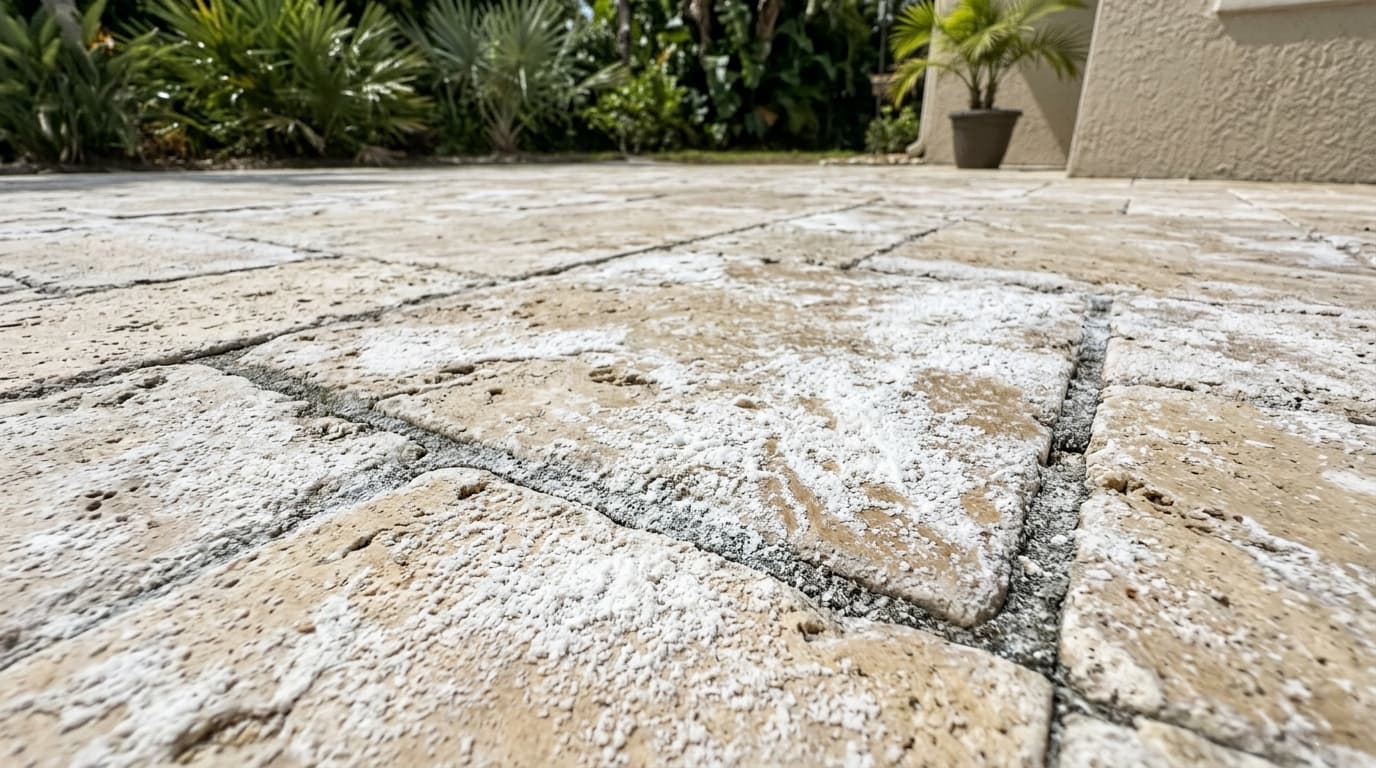
| White powdery residue | Efflorescence on the surface or at edges and joints | Moisture is carrying salts up through the floor |
| Dark or damp patches | Spots that appear after rain or stay cool and damp | Water vapor or liquid water reaching the surface |
| Bubbling or blistering | Raised areas in an epoxy surface | Vapor pressure pushing against the bond. Ask about terrazzo repair once the cause is found |
| Hollow sounds or lifting edges | A dull sound when tapped, or edges and strips coming loose | The bond between terrazzo and slab is weakening. A terrazzo repair may be needed after the moisture source is fixed |
| Musty smell or visible mold | Odor, or dark growth near edges, baseboards, or cracks | Persistent dampness underneath or nearby |
| New cracks at joints | Hairline cracks that return after repair | Movement or moisture issues; compare crack repair options |
None of these proves moisture is the cause on its own. A professional inspection and slab testing sort moisture from other problems such as structural movement or poor surface prep.
How to Test a Slab for Moisture: Calcium Chloride vs. RH Probe
Two standard tests are used on concrete slabs. Both measure moisture, but in different ways, and installers often use the RH probe because it reads conditions deeper in the slab.
| Feature | Calcium chloride test (MVER) | In-situ RH probe test |
|---|---|---|
| Standard | ASTM F1869 | ASTM F2170 |
| What it measures | Moisture vapor emission rate from the surface | Relative humidity inside the slab |
| How it works | Calcium chloride is weighed, sealed on the slab, and weighed again after 60 to 72 hours | Holes are drilled, sleeved, and capped for at least 72 hours before readings are taken |
| Reported as | Pounds of moisture per 1,000 sq. ft. per 24 hours | Percent relative humidity |
| Watch out for | One manufacturer's data sheet says not to use it unless the building is fully climate controlled | Needs the space at or near occupancy conditions for a reliable reading |
What counts as an acceptable reading? There is no single number for every job. The limit comes from the terrazzo or primer manufacturer. As a reference point, IMI's guidance for epoxy terrazzo calls for slab humidity below 80% unless the manufacturer requires lower. One mitigation primer's data sheet lists tolerance up to 20 pounds per 1,000 sq. ft. per 24 hours on the calcium chloride test, and tells installers to contact technical support when humidity passes 95%. Always follow the specific system you are installing.
These numbers can look different from the general flooring thresholds in our humidity guide, which treat humidity above about 75% or an emission rate of 3 to 5 pounds as risky. General flooring guidance uses those lower figures, while terrazzo system limits are manufacturer-specific.
How Testing Leads to a Decision
The diagram shows the basic order of work. Test first, compare to the manufacturer's limit, then either proceed or fix the problem and retest.
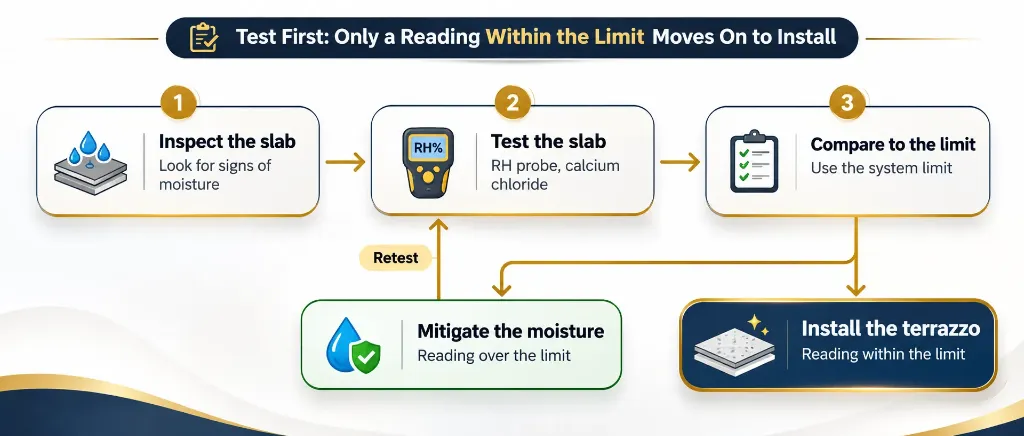
If the reading is over the limit, fix any water source, apply the mitigation system, and test again before installing.
Moisture Mitigation Systems and Membranes
Mitigation means controlling the moisture so the floor system can bond and stay bonded. Which option fits depends on test results, the type of terrazzo, and whether the slab is new or existing.
| System | How it works | When it is used | Notes |
|---|---|---|---|
| Under-slab vapor barrier | A reinforced barrier placed directly beneath the slab. IMI recommends one at or above ASTM E1745, 15 mil, for epoxy terrazzo. | New construction, before the slab is poured | Cannot be added to an existing slab |
| Epoxy moisture vapor primer or mitigation coating | A roller-applied epoxy layer over the prepared slab that blocks vapor | When tests exceed the limit, or the slab is damp or new | Each product has its own stated limits. See, for example, the T&M Supply data sheet and Key Resin's specification |
| Controlled environment and dry time | Bringing the space close to occupancy conditions so the slab can dry before the pour | Part of good practice for epoxy terrazzo (IMI) | Does not replace testing |
| Crack isolation membrane | A flexible layer that absorbs slab movement | Slabs with cracks or joints that move | Manages cracks, not moisture. Compare epoxy vs. polyurethane injection for crack repair |
| Breathable cementitious system | A cement-based terrazzo that lets vapor pass | Worth discussing when moisture cannot be controlled | Ask your installer whether it suits the slab and project |
For floors that are already installed, the finish matters too. Our terrazzo sealing service is worth discussing once the slab is confirmed to be within its limits.
What Happens If You Skip Moisture Mitigation
| Consequence | What happens | What you see |
|---|---|---|
| Bond failure | Vapor pressure and moisture weaken the bond between slab and terrazzo, especially with epoxy systems that cannot breathe | Bubbles, lifting, hollow sounds, loose edges |
| Efflorescence | Moisture carries salts to the surface and leaves them behind | White powdery deposits, cloudy patches |
| Mold and odor | Persistent damp conditions support mold growth. | Musty smell, dark growth near edges and cracks |
| Repeat repairs | Patching the surface does not fix the moisture source | Problems that keep coming back |
| Full redo | Failed terrazzo has to be removed, the slab prepared, and the floor reinstalled. See terrazzo restoration | Downtime, demolition, and a second installation |
Cost: Mitigation Up Front vs. a Failed-Install Redo
Mitigation is a small part of an installation. A redo means paying for the original install, then removal, slab prep, mitigation, and a second install. The table shows typical ranges for each part of the work.
Estimated Tampa Bay price ranges as of November 2026
| Service type | Average price range (Tampa Bay) |
|---|---|
| Slab moisture testing | $150–$300 basic residential, or $125–$175 per test point commercial (about $500–$1,200+ total) |
| Moisture vapor primer or mitigation coating | $1.50–$4.00 per sq. ft. installed |
| Crack isolation membrane | $2.50–$4.50 per sq. ft., or $2.00–$5.00 per linear ft. for localized work |
| Failed-install redo | $20.00–$50.00+ per sq. ft., compared with about $15–$40 for an initial install |
The lowest quote is not always the best value, especially when it leaves out testing.
Slab Moisture Testing at Tampa Terrazzo
Slab moisture testing is one of the specialized services Tampa Terrazzo offers. If you are planning an install or have a floor that is misbehaving, we can test the slab and explain how the reading compares to the system manufacturer's limit.
Test First, Then Install
The safest sequence is simple: inspect the slab, test it, compare the result to the manufacturer's limit, mitigate if needed, retest, and only then install. It adds little to a project, and it protects the most expensive part of it. If you want to see what a full job looks like, see how a full restoration works.
If you have a floor that is bubbling, lifting, or showing white residue, or you are planning a terrazzo install on a slab-on-grade, request a free estimate. We serve Tampa, St. Petersburg, Clearwater, and Brandon. You can browse recent projects and read customer reviews first.
Frequently Asked Questions
Why is my terrazzo floor bubbling or lifting?
Bubbling and lifting often point to moisture vapor pressure or a weakened bond between the terrazzo and the slab. Cracks, poor prep, and movement can cause similar signs, so testing and an inspection are needed to find the cause.
How do you test a concrete slab for moisture before installing terrazzo?
The two standard methods are the calcium chloride test (ASTM F1869) and the in-situ relative humidity probe test (ASTM F2170). Installers often prefer the RH probe. Results are compared to the manufacturer's limit for the system being installed.
What is an acceptable moisture level for epoxy terrazzo?
It depends on the manufacturer. IMI's guidance calls for slab humidity below 80% unless the manufacturer requires lower, and mitigation products list their own limits. Confirm the number with the specific system data sheet.
Do I need a vapor barrier under terrazzo in Florida?
For epoxy terrazzo, IMI recommends a reinforced vapor barrier under the slab on new construction. On an existing slab you cannot add one, so testing and a moisture primer are the usual tools.
Can terrazzo be installed over a damp slab?
Only if the moisture is controlled first. Some epoxy primers are made for damp or new concrete, but each has stated limits. Installing without testing risks bond failure.
What is the white powder on my terrazzo floor?
It is most likely efflorescence, which is salt left behind as moisture evaporates. It suggests moisture is moving through the floor, so the source should be checked, not just cleaned.
Is epoxy or cementitious terrazzo better for moisture problems?
Cement-based terrazzo is more breathable, while epoxy terrazzo needs the slab moisture controlled. The right choice depends on the slab and the project.
How much does terrazzo moisture mitigation cost in Tampa?
Estimated Tampa Bay ranges as of November 2026: slab moisture testing runs about $150 to $300 for a basic residential job, and a moisture vapor primer or mitigation coating runs about $1.50 to $4.00 per sq. ft. installed. Final cost depends on slab size, test results, and the system used. Request a free estimate for your slab.
Semantic Keynotes & Named Entity Recognition (NER) Tags ▼
Semantic Keynotes
- Primary Conceptual Themes: The critical necessity of subfloor concrete slab moisture testing and mitigation prior to terrazzo installation, emphasizing the impermeable vapor barrier characteristics of modern thin-set epoxy terrazzo vs. traditional breathable cementitious terrazzo systems in Florida's humid, slab-on-grade environment.
- User Intent Targets: Targets commercial architects, builders, facility managers, and residential property owners seeking diagnostic guidelines on slab moisture vapor emission rates (MVER), in-situ relative humidity (RH) probe testing, and epoxy moisture primers to prevent catastrophic terrazzo bond failure, blistering, and delamination.
- Core Value Proposition: Over 48 years of specialized stone and terrazzo restoration mastery by Tampa Terrazzo (Al Spicer), delivering precision slab moisture testing (ASTM F2170 & ASTM F1869) and warranted mitigation coatings to avoid costly redo tear-outs and reinstallations ($20–$50+/sq. ft.).
- Strategic GEO & AI Search Takeaways: Engineered for Generative Engine Optimization (GEO) with rapid extraction modules (Quick Answer, diagnostic comparison tables, manufacturer threshold limits from IMI, T&M Supply, Key Resin) and hyper-local Tampa Bay geoclimatic parameters (30-inch summer monsoon rainfall, high water table, porous sandy subsoil).
NER Tags
- ORGANIZATION & BRANDS: Tampa Terrazzo, International Masonry Institute (IMI), National Terrazzo and Mosaic Association (NTMA), Key Resin Co., Terrazzo & Marble Supply (T&M Supply), ASTM International.
- PERSON: Al Spicer (Owner & Lead Terrazzo Specialist, Tampa Terrazzo).
- PRODUCTS, SERVICES & SOLUTIONS: Subfloor Moisture Mitigation, Terrazzo Floor Installation, Slab Moisture Testing, In-Situ Relative Humidity (RH) Probe Testing, Calcium Chloride Moisture Vapor Emission Rate (MVER) Testing, Epoxy Moisture Vapor Primer, Moisture Mitigation Barrier Coating, Crack Isolation Membrane, Breathable Cementitious Terrazzo, Terrazzo Restoration, Terrazzo Crack & Chip Repair, Penetrating Terrazzo Sealing.
- TECHNICAL SPECIFICATIONS & STANDARDS: ASTM F2170 (In-Situ Probe Relative Humidity), ASTM F1869 (Anhydrous Calcium Chloride Vapor Emission), ASTM E1745 (Plastic Water Vapor Retarders), 15 Mil Under-Slab Vapor Barrier, 80% Internal Relative Humidity Threshold, 20 lbs / 1,000 sq. ft. / 24 hr MVER Tolerance, Hydrostatic Pressure, Efflorescence Salt Migration, Delamination, Slurry Containment.
- STRATEGIC & FUNCTIONAL CONCEPTS: Non-Negotiable Moisture Mitigation, Bond Failure Prevention, Vapor Drive, Slab-on-Grade Moisture Dynamics, Florida Subtropical Humidity, Mitigation Upfront vs. Redo Cost Analysis, Decision Flow Protocol, Quick Answer Extractability.
- INFRASTRUCTURE & BUILDING ENTITIES: Concrete Slab, Slab-on-Grade Subfloor, Mid-Century Residential Subdivisions, Historic Commercial Buildings, Coastal Cottage Foundations, Lanais, Pool Decks, Baseboards, Construction Joints.
- CONTACT, CHANNELS & GEOGRAPHIC DATA: Tampa Bay Area, FL, Tampa, FL, St. Petersburg, FL, Clearwater, FL, Brandon, FL (1409 Sunnyhills Dr, Brandon, FL 33510), Hillsborough County, Pinellas County, Pasco County, Phone: 813-842-2255, Email: bestchoice2022@gmail.com, Website: tampaterrazzo.com.
Recent Posts
Subfloor Moisture Mitigation for Terrazzo: Why It's Non-Negotiable
How Often Should You Seal Pavers in Florida? (UV & Humidity Guide)

Marble Etching Explained: Causes, Prevention & How to Fix It


Your Go-To Concrete Care Guide
How to Choose the Best Floor Restoration Company