What Florida's Humidity Does to Hard Surfaces That Other Restoration Companies Often Miss
⚡ Quick Answer
Tampa Bay's average relative humidity runs near 74% year-round — often above 88% in the morning — with roughly 49 inches of rain falling annually, most of it between June and September. That combination drives moisture through terrazzo, marble, travertine, concrete, and pavers long before any damage is visible, which is why surface restoration in Tampa needs a climate-specific, material-specific approach rather than a generic fix.
Living in Tampa Bay, it is easy to notice what the weather does to people. The heat makes you slow down, the afternoon rain appears out of nowhere, and humidity seems to settle over everything. What is less obvious is what that same combination of heat and moisture is doing to the hard surfaces around a property. Terrazzo floors, marble, travertine, concrete, pavers, and other hardscaping deal with these conditions every day. Some of the damage is obvious. Other changes happen gradually, often underneath the surface or in places that are easy to overlook. That is where Florida's climate becomes an important part of restoration work.
A Surface Can Look Dry Without Being Free From Moisture
Moisture does not always announce itself with standing water. It can move through porous materials, collect in areas with poor drainage, or remain below a finished surface. By the time a homeowner notices a dark patch, cloudy appearance, discoloration, or white residue, the original moisture problem may have been present for quite some time.
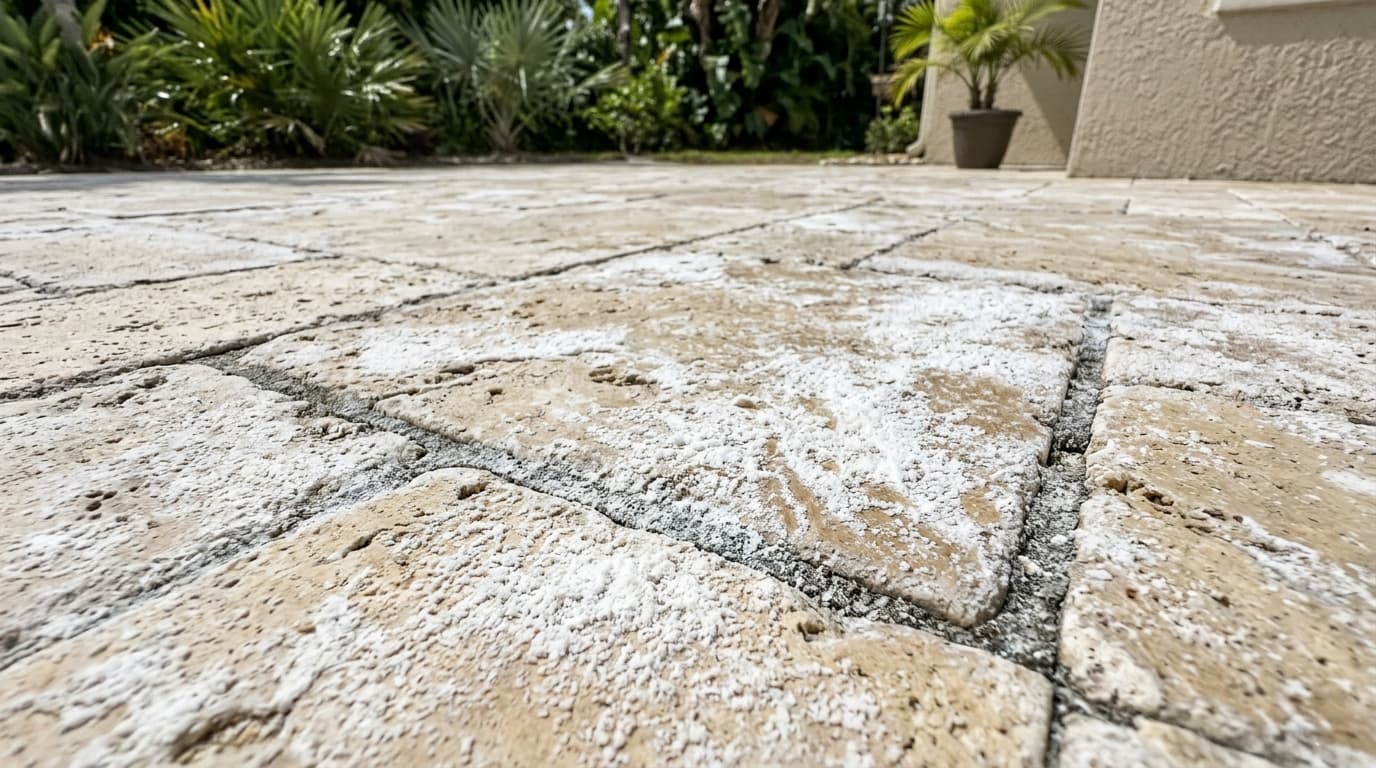
This is especially relevant with natural stone and concrete. A discolored area might be a stain. It might also be related to moisture movement. A white, powdery deposit may not mean that the stone itself has changed color — it could be efflorescence, which forms when water dissolves soluble salts inside the material and carries them to the surface as it evaporates. Treating the visible mark without figuring out why it appeared can be a waste of time. In some cases, it can create another problem.
How efflorescence actually forms
Efflorescence needs four conditions working together: soluble salts already present in the material, moisture to dissolve them, a driving force pushing that solution toward the surface, and evaporation to leave the salts behind. Evaporation happens faster in the summer, so efflorescence in Tampa Bay is often more visible after a shift from a wet stretch of weather into hot, sunny days — exactly the pattern the region cycles through for months at a time.
Common signs and what they usually mean
| Visible Sign | Likely Mechanism | Surfaces Most Affected |
|---|---|---|
| Dark or damp-looking patch that will not dry | Subsurface moisture wicking through the material's pores | Terrazzo, natural stone, concrete |
| White, powdery residue | Soluble salts carried to the surface as water evaporates (efflorescence) | Concrete, pavers, unsealed stone |
| Cloudy or hazy film beneath a sealer | Moisture vapor trapped under a low-permeability coating | Sealed terrazzo, coated concrete |
| Cracking or flaking of a finish | Pressure from salt crystallization beneath the surface | Painted or coated masonry, stucco |
| Sheen loss or dulling in high-traffic areas | Combined moisture exposure and foot-traffic wear | Interior terrazzo and marble floors |
What We're Actually Seeing on Tampa Bay Properties
Climate normals explain why moisture is a constant risk in Florida, but what matters on the ground is how it shows up on local jobsites. Across 48 years of continuous service and over 500 completed restoration projects in Hillsborough and Pinellas counties, founder and principal craftsman Al Spicer consistently finds that over 70% of non-routine restoration calls—from mid-century interior terrazzo to outdoor living spaces—stem from sub-surface moisture and seal-failure rather than simple surface wear.
A primary example is outdoor patio and paver restoration across South Tampa, St. Petersburg, and Pinellas County. Intense UV exposure combined with 70–90% ambient relative humidity breaks down traditional exterior sealers two to three times faster than in drier climates. As these non-breathable sealers degrade under the sun, they trap rising moisture vapor beneath the surface, resulting in severe clouding, grout failure, and dark discoloration.
Remediating these surfaces requires mechanically stripping away the sun-baked coating, restoring damaged grout or sub-structures, and applying a moisture-vapor-permeable (breathable) impregnating sealer. By allowing the concrete slab or natural stone to breathe while repelling surface water, the material can withstand Tampa's extreme climate cycle without trapping moisture underneath.
The Numbers Behind Florida's Moisture Problem
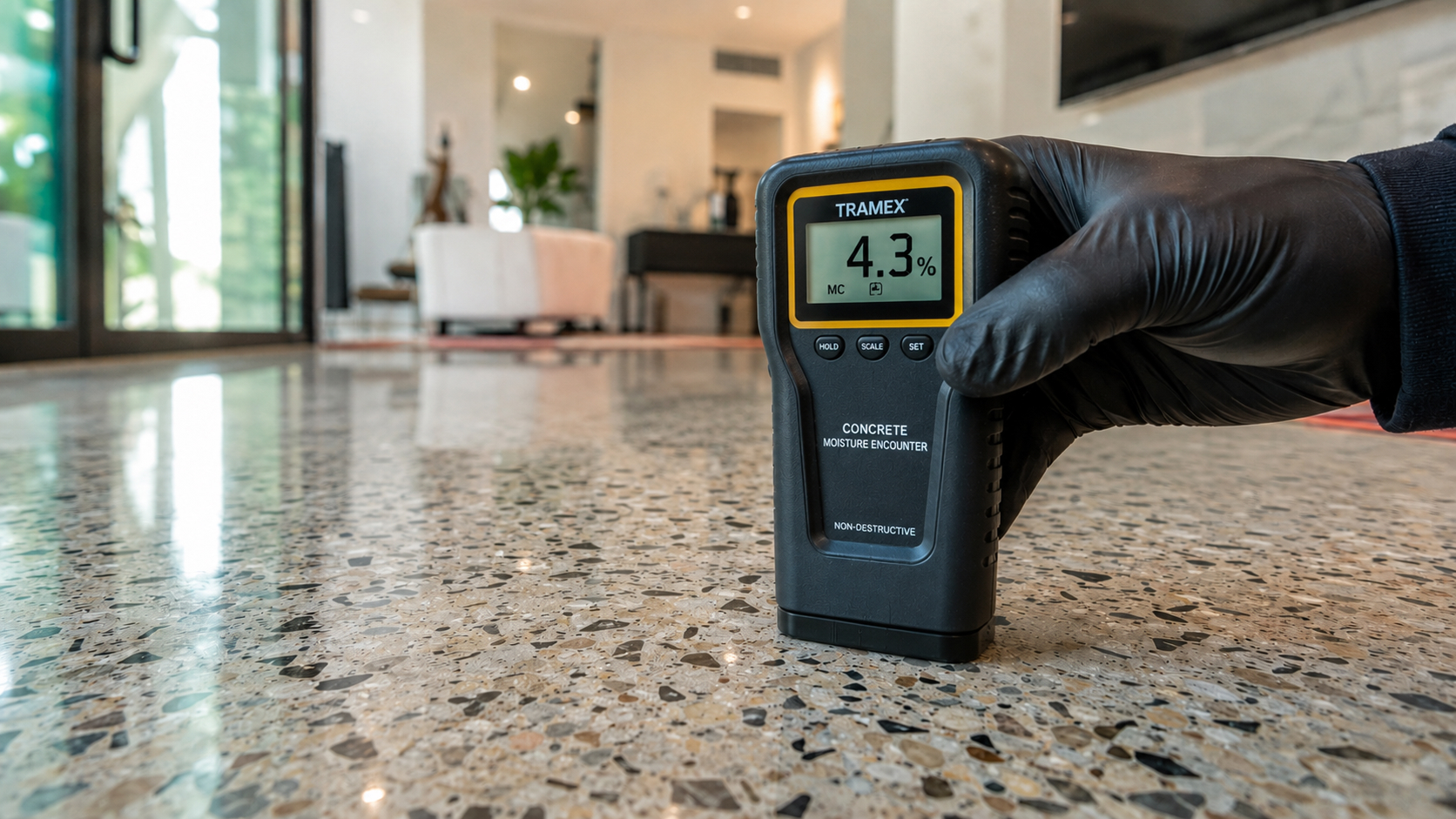
Florida does not have one difficult weather condition — it has several working together, and the data behind them explains why hard-surface restoration in Tampa Bay cannot follow an out-of-state playbook.
| Metric | Tampa Bay Figure | Source |
|---|---|---|
| Average annual relative humidity | ≈74% overall (≈88% morning / ≈57% afternoon) | NWS station data, compiled via Current Results climate summaries |
| Most humid month | December, averaging ≈75% relative humidity | NWS long-term normals |
| Average annual rainfall | ≈49.4 in. (1991–2020 normal), measured at Tampa International Airport | NOAA National Centers for Environmental Information |
| Wettest month | August, averaging ≈9.0 in. with rain on over half the days in the month | NOAA 1991–2020 climate normals |
| Rainy season concentration | Roughly 60% of annual rainfall falls June–September | NOAA / National Weather Service Tampa Bay |
| Record annual rainfall (recent) | 80.29 in. in 2024, well above the long-term average | NWS Tampa Bay station records |
| Moisture threshold for coatings/sealers | >75% internal relative humidity (ASTM F2170) or >3–5 lbs./1,000 sq. ft./24 hrs. MVER (ASTM F1869) | ASTM International; American Society of Concrete Contractors |
Two things stand out in that data. First, Tampa Bay's humidity rarely drops low enough, for long enough, to let a porous surface fully dry out between rain events — mornings above 85–90% relative humidity are routine, not exceptional. Second, the industry's own moisture thresholds (ASTM F1869 and F2170) sit well below what a Tampa slab or stone installation can regularly experience without protection, drainage correction, or a breathable sealer system. That gap is a major reason products and methods that work in a dry climate can fail here.
Tampa Weather Changes How Restoration Should Be Approached
Exterior surfaces have to handle all of this while continuing to deal with everyday use. A patio, walkway, driveway, or pool area is exposed to a very different environment than an interior terrazzo floor. Even within the same property, two surfaces may need completely different approaches.
This is one reason restoration techniques should not simply be copied from another region. A method that makes sense in a dry climate may not account for the amount of moisture present in a Tampa Bay property, especially during the June–September rainy season when nearly six in ten inches of the year's rainfall arrives. Products need to be selected with local conditions in mind, and the condition of the surface needs to be understood before work begins.
At Tampa Terrazzo, the starting point is understanding the surface and what caused the problem. Terrazzo has its own requirements. Marble has its own behavior. Travertine needs to be assessed differently again. Concrete and outdoor hardscaping bring their own concerns. That approach matters in any region, but especially in Florida — a restoration job has to account for what the surface is made of and what the environment is doing to it.
Sometimes the Right Answer Is a Smaller Job
A property does not automatically need the most extensive treatment available. If a simpler service can solve the problem properly, that may be the better choice. The important thing is knowing the difference.
After 48 years of working with the surfaces found throughout Tampa Bay properties, Tampa Terrazzo has developed its approach around that idea: look at the material, understand the problem, consider the environment, then decide what the surface actually needs. Florida's climate is not going to change because a restoration project is finished. The humidity will return — averaging near 74% year-round. The rain will come back — nearly 50 inches of it most years. The sun will keep beating down on outdoor surfaces. Good restoration takes those conditions into account from the beginning, rather than treating them as an afterthought.
Frequently Asked Questions
How humid is Tampa Bay compared to other Florida cities?▼
Tampa averages close to 74% relative humidity year-round, with mornings frequently exceeding 88% and afternoons settling closer to 57%. That places it in line with other Gulf Coast Florida cities like Fort Myers and Jacksonville, and it is one of the reasons porous surfaces here stay damp longer than in drier climates.
What causes efflorescence on terrazzo, concrete, or pavers?▼
Efflorescence is a white, powdery mineral deposit that forms when water moves through a porous material, dissolves soluble salts, and evaporates at the surface, leaving the salts behind. It requires soluble salts, moisture, a driving force, and evaporation — all four are common in Tampa Bay's climate cycle of heavy rain followed by hot, sunny days.
How much moisture is too much for a concrete or stone surface?▼
Industry standards under ASTM F1869 and ASTM F2170 generally treat a moisture vapor emission rate above 3–5 lbs. per 1,000 sq. ft. per 24 hours, or an internal relative humidity above 75%, as high enough to risk coating failure, efflorescence, or adhesive breakdown — thresholds that humid coastal properties in Tampa Bay can reach more often than drier regions.
Does Florida's climate get worse for hard surfaces during certain months?▼
Yes. Roughly 60% of Tampa's annual rainfall falls between June and September, with August alone averaging around 9 inches. Combined with summer humidity that regularly climbs into the high 70s and low 80s, this stretch of the year carries the highest risk of moisture intrusion for terrazzo, natural stone, and concrete.
Can a surface look fine and still have a moisture problem underneath?▼
Yes. Moisture can travel through porous stone or concrete and collect below the surface without producing visible standing water. It often shows up later as discoloration, cloudiness, or efflorescence, well after the underlying issue began — which is why an assessment should look past the visible mark before recommending a fix.
Does every moisture-damaged surface need a full restoration?▼
No. A property does not automatically need the most extensive treatment available. Tampa Terrazzo assesses the material, the likely cause, and the surrounding environment first, then recommends the smallest service that will actually solve the problem — rather than defaulting to the largest one.
Summary
Florida's intense heat and high humidity present unique challenges for hard surfaces like terrazzo, marble, travertine, concrete, and pavers. With relative humidity averaging near 74% and roughly 49 inches of rain falling most years — concentrated in a June–September rainy season — moisture moves through porous materials, often causing hidden sub-surface damage, discoloration, or efflorescence well before it is visible. Successful surface restoration in Tampa Bay requires understanding local climate data and material behavior rather than relying on generic, out-of-state methods.
Semantic Keynotes & Named Entity Recognition (NER) Tags▼
Semantic Keynotes
- Hidden Moisture Damage: Humidity and moisture move through porous hard surfaces, causing stains, cloudiness, or white powdery residue (efflorescence) well below the surface.
- Climate-Specific Approach: Tampa Bay's ≈74% average humidity, ≈49-in. annual rainfall, and June–September rainy season require restoration techniques tailored to each material type.
- Material Diversity: Different surfaces like terrazzo, marble, travertine, and concrete react differently to environmental stress and demand customized care.
- Targeted Solutions: A thorough assessment of the material and local environment ensures properties receive the precise level of service needed without unnecessary, extensive treatments.
- Local Experience: Companies with deep regional expertise, like Tampa Terrazzo with 48 years of experience led by founder Al Spicer, design restoration processes to withstand ongoing Florida weather.
NER Tags
- Locations (10): Tampa Bay, Tampa, South Tampa, St. Petersburg, Pinellas County, Hillsborough County, Florida, Fort Myers, Jacksonville, Tampa International Airport
- Materials/Services (9): Terrazzo, Marble, Travertine, Concrete, Pavers, Hardscaping, Grout, Stucco, sealer types
- Standards/Sources (5): ASTM F2170, ASTM F1869, ASTM International, NOAA, National Weather Service
- Named people/orgs (2): Al Spicer, Tampa Terrazzo
Recent Posts
Marble Etching Explained: Causes, Prevention & How to Fix It

Your Go-To Concrete Care Guide
How to Choose the Best Floor Restoration Company